When it comes to online privacy, the facts are pretty similar to a puzzle that has many pieces all looking alike. In reality, you may have heard of VPNs, and you probably also heard of proxies. Truth be told, both VPNs and proxies promise to hide your IP address, but they are two different tools offering different levels of protection.
It is safe to say that a proxy is a simple disguise, whereas you can see a VPN as a suit of armor that covers the wearer, i.e., someone on the internet. Knowing the differences that exist between a VPN & a proxy is the first thing you must do to hide and safeguard yourself on the internet.
Read along as we have covered the major differences between these two privacy tools. Compare them to see which one suits you the best.
Quick Comparison: VPN vs. Proxy
Before we continue the journey, here’s a quick and simple comparison:
| Features | VPN | Proxy |
|---|---|---|
| Data Encryption | Full, strong encryption | Usually none |
| Traffic Handled | All of your device’s traffic | Only specific app or browser traffic |
| Server Locations | Global, with thousands of servers | Can be limited and unreliable |
| Ideal For | Privacy, security, streaming, public Wi-Fi | Basic IP masking for specific tasks |
| Logging Policy | No-logs policies are a must | Free proxies often log and sell data |
| Speed & Stability | Fast and stable (with a quality provider) | Can be fast (no encryption), but often unstable |
| Cost | Almost always a paid service | Many are free, which is a major red flag |
What is a VPN?
A Virtual Private Network (VPN) is a great tool that protects people’s privacy on the internet. When you use a VPN app, it will mask your IP address first and also create a private and safe tunnel for all your data.
This tunnel encrypts your data to make sure that no one who tries to follow your path can read what you’re doing online.
How VPNs Work?
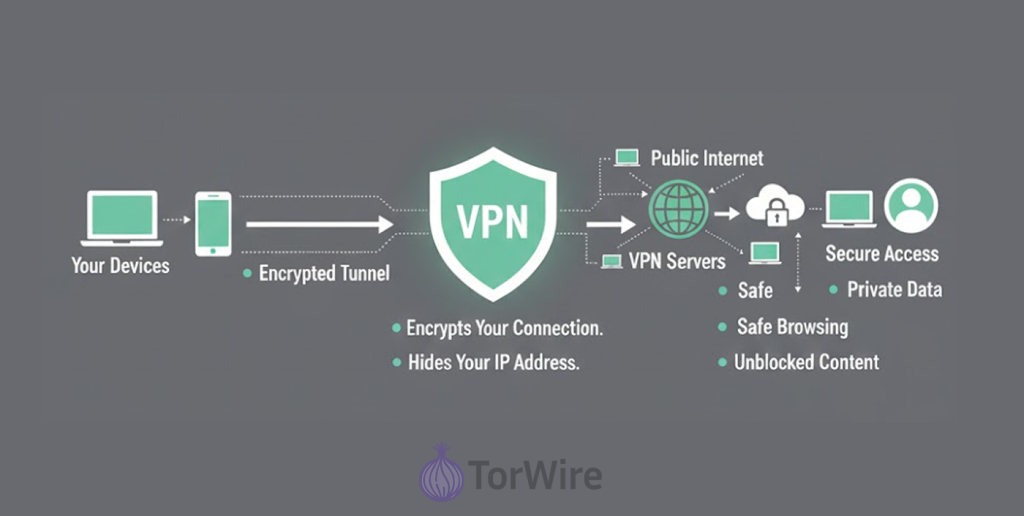
You can simply say that a VPN is the armored car that you hide in while doing anything on the internet. It doesn’t allow your data to go straight from the device to any website, but it spins it to confuse criminals and monitoring agents. How does it all work?
- Connection: You launch the VPN app you installed & choose a server in a location you prefer, let’s say Japan. Once you do that, your device will connect to that server in a very secure way.
- Encryption: This is where a lot of the magic happens. Before your data flows out of any device you’re using, the VPN service converts it into an unclear & difficult-to-read code using complex algorithms. This process is called “encryption”, & the reason for it is to protect your activities from prying eyes, including the government, criminals, your ISP, or anyone else who is monitoring your connection. Your data will appear in a gibberish format, and they can’t see what you’re doing online.
- Redirection: After encryption, your data will travel through a tunnel to the server of your VPN service in Japan.
- Decryption & destination: When it gets to that server, the data will be decrypted, and then it moves to the website you were initially visiting. When the website receives your traffic, it believes it is coming from the location of the VPN server, not the real place where you are.
One thing you must appreciate about a VPN is that it not only hides your web traffic but also provides anonymity while using apps on your device. It protects everything from your email client to your favorite game.
What is a Proxy?
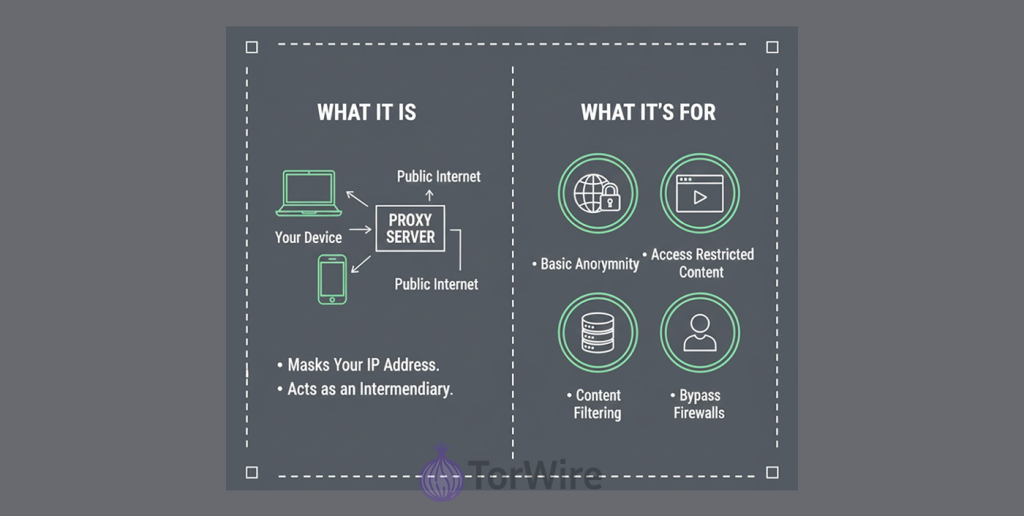
A proxy server is a simple intermediary. It sits between you and the website you are visiting. Its job is to serve as a go-between, resolving your web requests to a website.
When you use a proxy and go to a website, your IP address is simply swapped with the IP of the proxy server. However, there is one big thing to consider seriously here: proxy servers don’t have the power to encrypt your traffic.
This means that while it can hide your traffic from the world, anyone who has the right tools, like your ISP, can actually see it.
The lack of encryption is a key drawback and is likewise an essential difference between a proxy and a VPN. A proxy hides your IP, but a VPN offers both online privacy and protection. Proxies are best for simple tasks, but not the serious security that a VPN can offer.
Main Types of Proxy Servers
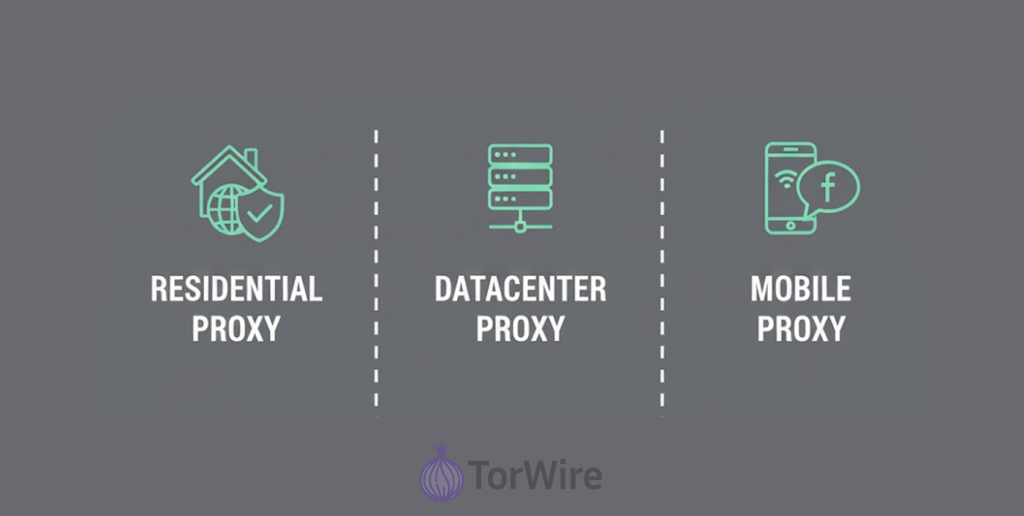
There are tons of different proxies out there. Each proxy can have its own oddities. These are the most common ones.
- HTTP Proxies: These are the most common proxies for web traffic. Their work is mainly to change your IP addresses and bypass geo-restrictions.
- SOCKS5 Proxies: This one is more flexible and can handle any type of traffic you can think of, such as video streams, torrents, & games. While SOCK5 proxies can be more flexible, they still do not have the power to encrypt your data. That means there is no fair comparison of a VPN vs a proxy for gaming.
- Transparent Proxies: Frequently used by employers and public Wi-Fi sources. These proxies are “transparent” because the user does not know that they are utilized (it is the least ethical proxy). Transparent proxies can perform content filtering well, but give zero anonymity.
- Anonymous Proxies: These proxy servers hide your real IP address, but still show that you are using a proxy.
- Elite Proxies (High Anonymity): These are arguably the best in terms of anonymity. It’s because they hide both your IP address and the fact that you are using a proxy.
- Residential Proxies: These use IP addresses that have been assigned by an ISP to a real home or mobile device. They’re tough to detect and are often used for specific tasks with specific parameters, like web scraping.
- Data Center Proxies: These proxies are not related to an ISP. They’re fast and cheap, but many major websites and streaming services will usually flag these IPs and ban them for violation of the terms of service.
Key Differences Between VPN and Proxy
This is where things get interesting. While both hide your IP, the real differences come down to security and functionality.
Security and Encryption
This is the big one. A VPN’s main purpose is to protect your data with military-grade encryption. A proxy’s main purpose is to change your IP address. It’s like applying for any given job under a different name—you might get the opportunity to go in for an interview, but you can’t wipe your history. So if you’re scrolling the web pages without encryption, there’s a high probability that you are unsafe.
Privacy and Logging
When you use a VPN, a quality provider won’t keep logs of your activity because it maintains a strict no-logs policy. So, there’s no record of what you did online. Considering a free VPN, there’s no such guarantee, as they often log your data and sell it to third parties.
Many free proxy services collect and sell your personal data to advertisers. Let’s be real: if a service is free, you’re not the customer, you’re the product. We found it on the VPN vs. proxy Reddit discussion that this is the number one warning users give.
Coverage
A VPN provides system-wide protection. Once you connect, all the traffic you’re sending is protected—this includes apps, games, or the browsers you’re using.
But a proxy only works for one application. By adding a proxy in your browser settings, you will ensure your browsing traffic is protected. On the other hand, the rest of your apps will not have any protection.
Performance (Speed and Stability)
A premium VPN offers thousands of fast and stable servers. While the encryption adds overhead, it is a small price to pay for the security you’re getting from the VPN. A good quality VPN has a massive network of servers that you can connect to, and uses fast protocols like WireGuard, so the speed drop is often virtually unnoticeable.
Proxies can sometimes be a little faster since they do not encrypt. However, proxies can be extremely unstable and unreliable, especially if you’re using free proxy services.
Cost
This is a no-brainer. While there are a few decent free VPNs (that come with limitations), the most reliable VPNs are paid. Proxies are often free, but as we just discussed, that “free” can come at a very steep price.
Ease of Use
A quality VPN service comes with user-friendly apps for almost every device—from Windows and macOS to your mobile phone, so it’s simple to use a VPN vs proxy on iOS or Android. You just click a button and you’re protected. Proxies want you to set and tell them how to work in your browser or application.
When to Use a Proxy vs. a VPN
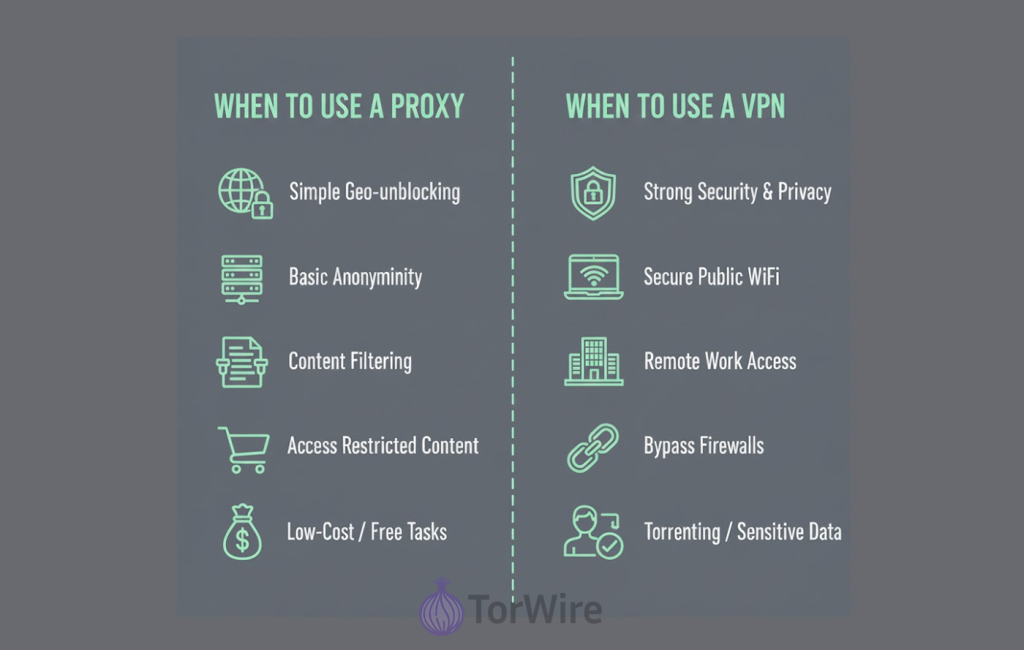
While VPNs are generally a better choice when security is a priority, there are some use cases for a proxy, also.
When You Should Use a VPN
- For total privacy: Every time you want to do anything that must stay private, a VPN must be there. For example, when you do any online banking, shopping online with your card or even discussing sensitive matters, never do them without a VPN.
- On public Wi-Fi: Seriously. If you are on an unsecured network, using a VPN is the most basic step in keeping your data safe from hackers.
- For streaming: If you want to access a Netflix library from another country or want to stream with no buffering, a VPN is going to be your best bet.
- For torrenting: If you are going to download or upload anything, VPNs are also super important for encrypting your activity to disguise it from your ISP.
When to Use a Proxy
- For quick, unsecured geo-bypass: If all that you are trying to do is access a website that has geo-blocked your country, and you are not doing anything sensitive, then a proxy is a very fast way to accomplish this.
- For web scraping: Proxies are generally faster, since they are not encrypted. Therefore, proxies are the best way to go for web scraping and gathering data.
- For content filtering: Schools and businesses use proxies to restrict access to certain sites within their domain.
Do You Need a Proxy if You Have a VPN?
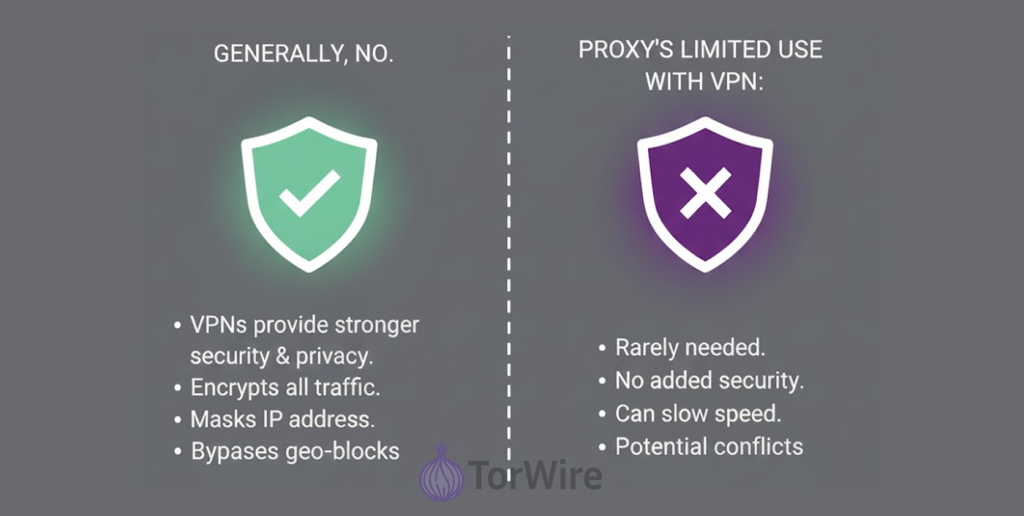
Most people want to know, and the answer is overwhelmingly no! A VPN does everything a proxy can do and is even better.
A proxy is like a lock on your front door, whereas a VPN is a deadbolt, a security camera, and alarm, all in one. A VPN hides your IP address, while also encrypting everything, so your ISP, government, and hackers can’t see it.
There is no reason to use a proxy, another layer of potential problems, on top of a secure connection. It can actually slow your connection, and you still aren’t gaining added security by using a proxy.
Moreover, hackers would still have a way to get through your connections if the security of the proxy service you choose is not trustworthy. However, you can use it with a VPN, but it requires technical knowledge and the proxy service must be trustworthy.
Can I Use a VPN and a Proxy Together?
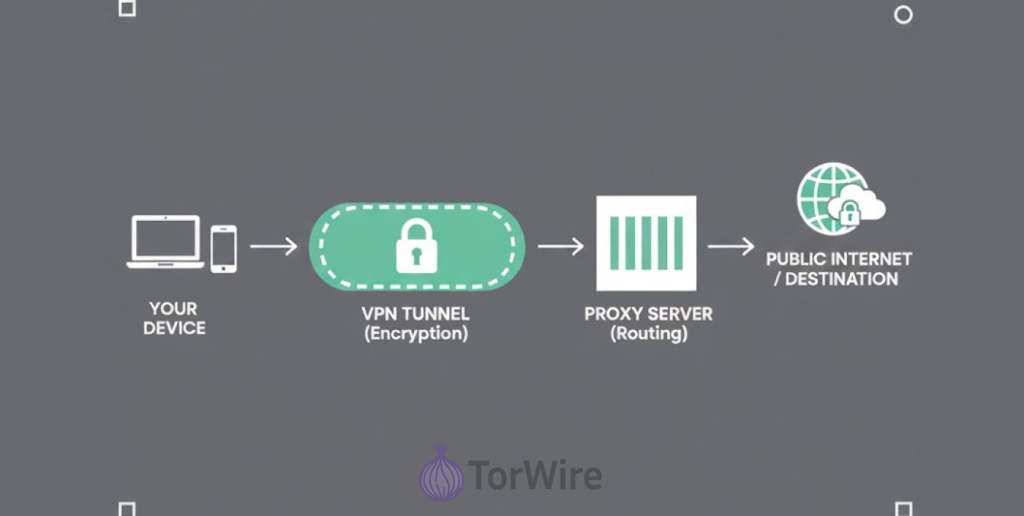
Yes, you can set up & run a VPN and proxy together, but this setup is not simple. Experts in this field call this setup “VPN over Proxy,” and it is usually for those who don’t want anything they do online to be visible to anyone. Some of such people are activists, journalists, and whistleblowers.
To handle this setup, those with the technical know-how will first connect to a secure VPN, & then configure a particular application (web browser or torrent client) to send all traffic over a specific proxy server.
This method masks your IP more than the ordinary approach, and no matter what others try, they’ll struggle to trace your traffic, if that is what you want to achieve.
The serious downsides to using a VPN with a proxy are: first, your connection will be very slow, and configuring this setup is not easy at all. Most importantly, security risks still exist when using proxies.
If you use a proxy that is not trustworthy, then who knows what risk you have just introduced into your traffic?
VPN or Proxy for Personal Use
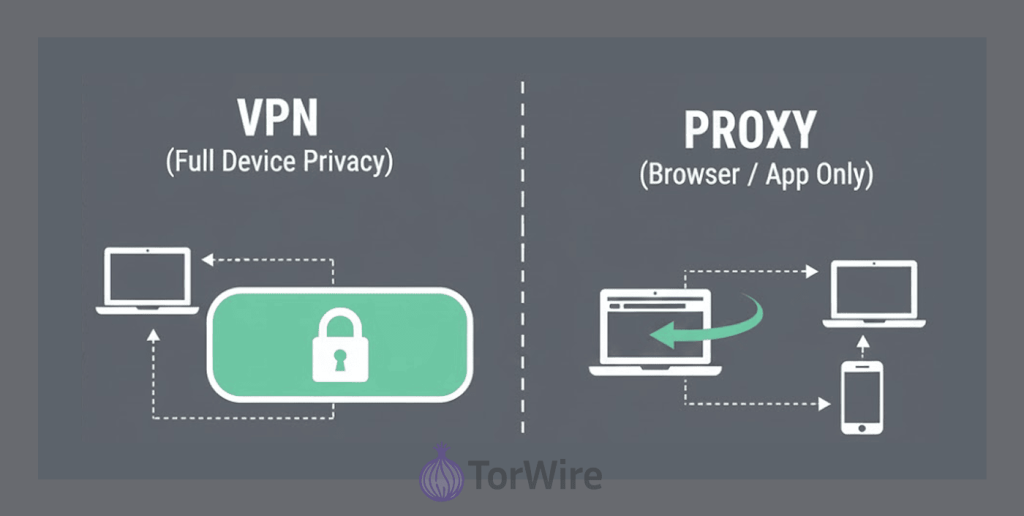
VPNs are your only reasonable choice for your everyday life. When you are at home, a VPN provides protection for all your smart devices. It will protect what you do on your smartphone and even your smart TV.
When you are not even at home, a VPN will still keep your secret information private or safe from others, especially when you use a network open to everyone, like those at cafes, airports, hotels, etc.
Whether you want to check your bank accounts, do some shopping online, or just ask Google some questions, a VPN will scramble your data, making sure no one knows what you’re doing.
However, a proxy is not that strong and won’t do all that for you, as it is weaker than a VPN.
Proxy vs. VPN for Businesses
When it comes to businesses, there’s just no comparison. No one is using a proxy for secure corporate communications or work-from-home situations.
A VPN is the de facto industry standard for safely accessing a company network and sensitive data from anywhere in the world. In addition, it is the only way to make sure all information is encrypted and protected against hackers.
In some situations, a proxy might be appropriate for low-level content filtering or for specific tasks where you are gathering data, like tracking a competitor’s pricing. However, proxies are simply too insecure to be used for business. It is just too risky to have your data exposed and vulnerable to malicious attacks.
The VPN vs Proxy business debate is a simple one: a VPN gives you real security, while you could say a proxy just provides you with a ‘costume’ for simple disguise.
VPN or Proxy for Torrenting
Always use a VPN for torrenting. Torrenting is public and not private, meaning that everyone on the network will share your IP address. But when you use a VPN, it will encrypt your traffic, and even your ISP can’t understand what you are doing.
On the other hand, a proxy has the power to hide your IP. However, it usually doesn’t encrypt your traffic, meaning that your ISP can still see that you’re torrenting & might send you a notice that you are using content that has copyrights.
Moreover, many proxies can be slower & not good to rely on because your connection might just drop during the process of torrenting and open up your IP to monitoring eyes. However, if you have a VPN with a “kill switch,” it will protect your privacy coast to coast.
Proxy vs. VPN for Streaming
This is a fun one; most of the questions are always about how a proxy and VPN work with streaming.
A VPN & proxy has the power to make sure you get content that Netflix blocked for people in your location. However, Netflix is improving its capabilities and using advanced VPN and proxy detectors to block those users.
Since proxies are not that high level in any of what VPNs can do, they are usually the first ones advanced systems detect and block.
If you really want to access a Netflix library in your region, a premium VPN is your best option. When you want to watch Netflix from a different country, go for the best VPN because such providers are constantly updating their servers to stay one step ahead of streaming services like Netflix.
The superior speeds of a solid VPN are necessary to stream high-definition media without annoying buffering. Also, when considering a fast, premium VPN, speed is even more important for things like a VPN vs. proxy for gaming or streaming, which require low latency and high bandwidth.
Proxy vs VPN: Which One is Better for You
This isn’t a fair comparison. A VPN is the clear winner for most people and for most use cases. If security, privacy, and the ability to access content with confidence are important to you, go with a VPN.
A proxy may accomplish your specific task on a temporary basis, but it won’t give you a lot more than that. It would be like wearing a paper shield in front of a sword.
In the end, it all depends on your needs. If you ask for our opinion, we would always choose a VPN over a proxy. And not any ordinary VPN service. We would use NordVPN, as it offers privacy, security, and speed. To be honest, that’s what we all need.
FAQs
A VPN provides more security than a proxy. It encrypts all your internet traffic, giving maximum protection and security to all your data. However, a proxy only has the power to hide your IP address, and will not encrypt your data or even secure your activities as you expect.
No. Free VPN and proxies are not reliable; they can put you in trouble. You might not know, but they frequently keep records of your activity and sell your info to third parties, like advertisers or may show you ads based on your habits.
Some free VPNs are okay to use lightly, but they come with a few limitations. If you need real security and unlimited data, you must pay for it by going for premium VPNs. However, if you’re on a budget, you can use the free version of Proton VPN or take advantage of the 30-day money-back guarantee policy of NordVPN and ExpressVPN.
Yes, VPN may reduce your internet speed because of the encryption. However, a decent provider like NordVPN uses advanced protocols that barely slow down your connection — you won’t even notice it.
