In today’s hyper-connected digital world, cyber threats are evolving just as fast as technology itself, putting individuals, businesses, and even governments at constant risk of attack. As hackers continue to search for system weaknesses, the need for stronger digital protection has never been greater.
This is where ethical hacking comes in. Ethical hacking is the legal practice of testing systems, networks, and applications to identify and fix security vulnerabilities before malicious hackers can exploit them.
Unlike cybercriminals who aim to steal or damage data, ethical hackers work with permission to strengthen security and protect sensitive information. In simple terms, it is one of the most effective ways organizations defend their digital assets and maintain trust in the online world.
In this guide, we’ll explore what ethical hacking is, how it works, its types, and its importance in modern cybersecurity.
What is Hacking?

Hacking is a process whereby someone gains access to a network, digital devices, or computer systems by making use of a loophole or vulnerability.
There are many forms in which hacking comes in, like disrupting company services, stealing sensitive and private data, spreading malware into devices or testing security defences in its target network or system.
However, it could be good or bad depending on what the hacker intends to do, such as research, improving security in networks or systems, activism, or criminal activities.
Hacking usually comes in 3 different categories: white hat, black hat, and gray hat hacking.
1. White Hat Hacking
This type of hacking follows ethical practices and only takes place with the authorization of the owners of the networks or systems. The main aim of white hat hacking is to improve cybersecurity.
Another name for these types of hackers is ethical hackers and organizations hire them to test their networks, applications, or systems for vulnerabilities. They work under what the law permits and make sure they do what their sector allows when trying to find weaknesses before bad actors do it.
Their work helps those who hire them to make their defences on the internet stronger, keep sensitive data in their custody safe, and make sure that the platforms people use are also secure.
2. Black Hat Hackers
Black hat hacking is the opposite of white hat hacking. It takes place when bad actors access computer systems, devices or networks with the aim to do harm. These hackers usually search for loopholes in these targets to use them and infiltrate the companies or individuals.
Once they have entered their destination, they will spread malware, steal private and sensitive information, disrupt the organization’s operations and make financial gains.
Their entire activities are against the law, and they usually aim to exploit individuals, government parastatals or businesses.
Above all, their main goal is to make money, and they don’t care about cybersecurity like their white hat counterparts. This is the reason their activities have become a serious threat in today’s digital world.
3. Gray Hat Hackers
These guys are between the white hat and black hat hackers. They could be illegal, but usually tip towards ethical hacking. Gray hat hackers gain access to systems, devices, and networks without getting the permission of the owners, thus breaking the law.
However, their intent is to discover weaknesses in systems and networks or devices too so they could report to the owners or reveal their findings publicly.
Gray hat hackers don’t do so to steal data or cause harm on targets for monetary gains. They could be seen as vigilantes of the digital world although unauthorized access is against the law.
After the explanations above, it is clear that what separates one hacker from the others in this categorization is the intent behind their actions. While the white hat hackers are hired to assist organizations in fixing issues, black hat hackers operate stealthily and in the dark to steal and manipulate. As for the third group, they do good deeds outside the provisions of the law.
Steps of Ethical Hacking: How it Really Works?
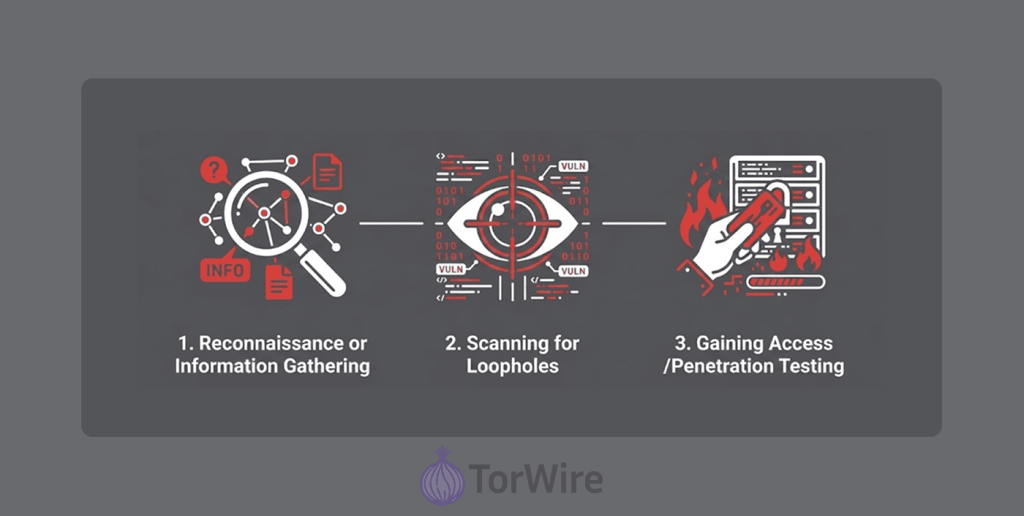
Ethical hacking follows a process structured in a way to help professionals in cybersecurity to find vulnerabilities in systems, devices and networks and fix them before black hat hackers find and exploit them.
This process doesn’t come without effort; white hat hackers usually use different testing methods, special tools, and above all, permission from the employers before accessing security risks. They handle their jobs in a controlled and legal manner, making them different from other categories of hackers. The entire process of ethical hacking takes the steps below:
Step 1: Reconnaissance or Information Gathering
This is the first step, which takes the hacker through the journey of information gathering about the network, website, or system, as the case may be. What they need here will include network infrastructure, IP addresses, possible entry points, and domain details.
Step 2: Scanning for Loopholes
The aim here is to locate those places where loopholes exist, like open ports, and other weaknesses that cybercriminals could possibly rely on and attack. This step needs some special tools to find things like weak passwords, software bugs, or misconfigurations in the network.
Step 3: Gaining Access/Penetration Testing
Of course, once the white hat hacker finds the weak points, it is time to try using them just like the bad actors will do. So the hacker will also try to exploit what he found to enter the system, just like the criminals will do. He will create a real-world attack scenario to test the defences of the system.
Some of the tools they can use to do this are scanners, tools that can crack passwords, tactics criminals use in social engineering, scanners for vulnerability etc. Meanwhile, to make this step work, the penetration tester must really know the hacking techniques bad actors are using at the time. Also, he must know how experts in cybersecurity are handling things at the time to avoid messing up or breaking the law.
Step 4: Maintaining Access
The reason for this step is to let the hacker know how long a bad actor can stay in the system after entering before the security teams will detect the exploit. This will show the company how a bad actor might maintain control of the network once accessed.
Step 5: Reporting and Fixing
After the above steps, the hacker must have gathered enough information of what is wrong with the network or system. They will report the same to the company executives and recommend the right moves to make in the face of the discovery.
Further actions he takes will depend on the recommendations and the company’s reaction to them. This is one of the advantages of ethical hacking.
In some cases, most organizations will run a program alongside other methods of ethical hacking in play. They could run a bug bounty program or a Vulnerability disclosure program to bring in researchers and ethical hackers together to share knowledge of what they found out about the organization under scrutiny for a reward.
Why Ethical Hacking Matters?

Cyber threats are no longer minimal but now so pronounced and widespread. In fact the tactics are complex and changing every day to the extent that it is hard to say what the criminals will hit an organization with anytime they like.
As tension increases all over the world plus how fast cybercrime is growing, some of the criminal networks & organized crime groups are making moves every day to find security weaknesses and mess up systems on the internet.
Cybercriminals can attack sensitive national infrastructure, corporate systems, or personal data belonging to individuals, which might lead the victims to lose money and cause them serious issues.
One of the ways they do this is by hijacking routers. Not too long ago, the KadNap botnet infected over 14,000 Asus routers worldwide, turning ordinary home and office networking equipment into weapons for cybercrime, proving that even devices we don’t think about need constant security attention.
To really fight against these growing threats, organizations need to make their strategies for cybersecurity strong and must work with technologies that have the capacity to withstand anything criminals throw at them.
This is why ethical hacking has become an important and compulsory, not something just to consider. They will help the organizations to find where there is a possible leakage in their systems before black hat hackers find and exploit them.
By mimicking real cyberattacks in a controlled environment, ethical hackers help different businesses, important government agencies, and many other institutions make their security defenses stronger.
As new forms of malware, viruses, even ransomware, and other cyber threats turn up on the web, more work will also come up for ethical hackers. Funny how even AI is now making things easier for both white and black hat hackers alike.
Each of the groups is using AI to make their craft automatic and easy. AI makes the fight for cybersecurity more vicious because it can help anyone make their processes automatic and faster. It helps in gathering data and analyzing the same fast, no matter how large, and it also helps ethical hackers to find threats faster and react quickly.
So with their skills and AI working together, Ethical hackers can protect digital infrastructure, keep information safer, boost security in systems and make our digital world safer to use.
Types of Ethical Hacking
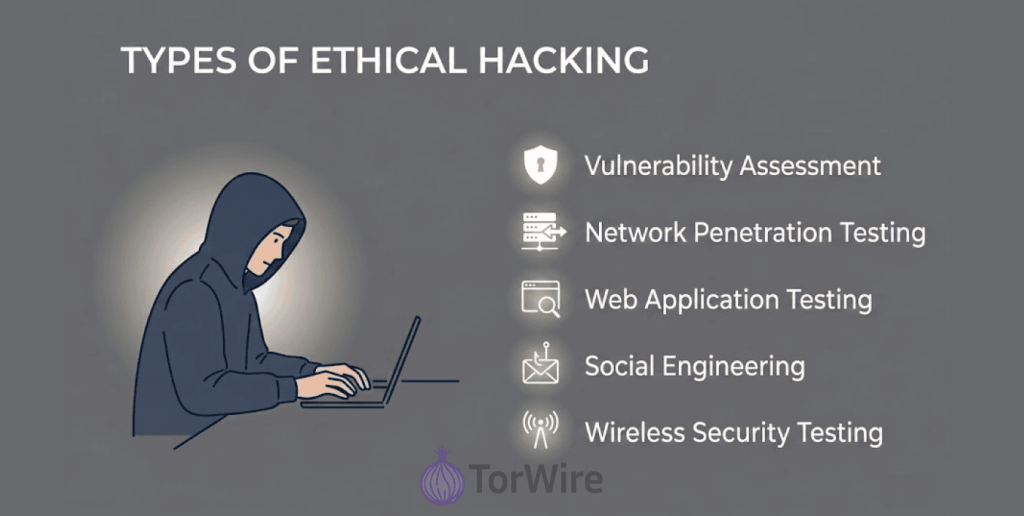
Experts can apply ethical hacking to different parts of an organization’s digital infrastructure. Each type of this skill focuses on finding out specific vulnerabilities that exist in companies’ systems, and networks, or even human behavior, all to make security stronger. Find the types of Ethical hacking below:
1. Network Hacking
This is the type that checks computer networks, firewalls and routers, and firewalls to find security weaknesses. What ethical hackers do here is to do vulnerability assessments & penetration testing to know if there are misconfigurations, open ports, or some other flaws that might allow criminals to enter without permission.
2. Web Application Hacking
Ethical hackers enter web applications or websites after the owners give them permission to check if there are problems with the security now or if there might be tomorrow. Some of the main things they must look at include trying to see if the authentication is responding well, SQL injection, and cross-site scripting (XSS).
3. System Hacking
Operating systems are the targets in this ethical hacking type. So the engineer will check the systems & the software they’re using to work all to find if there is any security gap. The things they can look into are software that is outdated, configurations that are not okay, weak permissions, or software “bugs” that attackers might use.
4. Social Engineering
Social engineering focuses on humans instead of machines. Ethical hackers tempt them with phishing emails, pose as the bosses (impersonation), or try to manipulate them in some other ways to see if they will expose sensitive information mistakenly.
5. Wireless Network Hacking
Ethical hackers try to check if there is enough security for the access points and Wi-Fi. To do that, they will test the configuration of the network and check the protocols used for encryption to make sure people without permission cannot enter.
Advantages of Ethical Hacking
The advantages of this type of hacking are more than you can imagine. One of them is to keep our digital world clean so that individuals, businesses & governments won’t lose to criminals. That’s why the industry has continued to grow every year by a whopping 13% to 23% due to the increase in cyberattacks & cloud adoption.
According to projections, the overall market growth might grow at a CAGR of 18.37% between 2025 and 2030, translating from $2.15 billion to $5 billion. This shows that the advantages of ethical hacking are numerous, as shown below:
1. Discovering Securities Vulnerabilities
Ethical hacking is a way that organizations can discover weaknesses in their networks, systems, servers, or even applications. Once the experts find out these loopholes, they’ll fix them ASAP before bad actors discover the same and exploit them.
2. Improving Network Security
Organizations employ the services of white hat hackers to analyze their network infrastructures and security controls so they can know if the protections in place have the capacity to secure them. With these hackers, organizations can build networks that are both very strong and resilient to stand against hits from cybercriminals.
3. Prevention of Data Breaches
Ethical hackers usually simulate real-world cyberattacks to find out possible entry points that attackers can utilize. After finding them, the hackers will fix them immediately so that sensitive data will remain secure, thereby saving future costs from data breaches.
However, even the best defenses can fail, which is why dark web monitoring is essential as a safety net, alerting organizations the moment their data appears on criminal forums so they can respond before the breach escalates.
4. Reduction of Financial and Business Risks
If organizations use white hat hackers to detect vulnerabilities very early, they could easily avoid cyberattacks which might cost them dearly if they occur.
Many times, companies face a lot of issues when criminals steal data from them. These losses could be financial losses, damage to their reputation, legal penalties for failing data protection laws, etc.
5. Ensuring Compliance to Regulation
Did you know that many industries work under very strong cybersecurity standards & laws to keep them in check? Any move outside these laws they will face the authorities and pay huge amounts as they will be fined.
This is why Ethical hackers will come in to identify areas of weakness and fix them, making sure that their systems and networks meet the security requirements that the authorities set for them.
6. Protection of Brand Reputation
Cyberattacks and data breaches usually damage the reputation that organizations spend years building. This is why ethical hacking is necessary to prevent such attacks by sealing up loopholes, thereby helping the organizations maintain their credibility and trustworthiness in the sight of their clients and customers.
7. Enhancement of Incident Response Speed
Any company that doesn’t know the weaknesses or loopholes which bad actors can exploit will be taken by surprise in a cyber attack. But if there is an awareness earlier on, it will be easy to respond faster if a breach eventually occurs.
8. Supports Continuous Security Improvement
Technology and cyber threats are usually evolving. That’s why organizations must conduct security assessments regularly so they can update their cybersecurity defenses continuously to make it stronger.
9. Help Test Systems Before Deployment
Sometimes, companies usually use the services of ethical hackers to check systems and networks they are already using to operate. However, to be more proactive, ethical hackers could check the systems at the early stages and seal up loopholes before they are deployed for operations, saving the companies from cyberattack threats.
Some Ethical Hacking Techniques to Note
White hat hackers employ many kinds of techniques in the attempt to find loopholes in any system, applications or network. The methods help them to imitate real-world cyberattacks in an environment they control with the authorization of their employers. Some of the common techniques most of them use include:
1. Social Engineering
This technique is all about manipulating people and not technology. White hat hackers might focus this technique on company employees to see how they will react to fake calls, phishing emails, or other tactics bad actors employ. The aim is to know if the company’s sensitive data will fall into the hands of criminals through human error.
The Italian spyware case shows that social engineering is just one way attackers gain access. In that instance, a journalist’s phone was hacked using sophisticated surveillance technology, proving that both technical vulnerabilities and human factors must be addressed to truly protect individuals and organizations.
2. Password Cracking
They break passwords with some special tools & techniques to know if they are strong enough. This will show them if bad actors can enter freely with weak or easy-to-guess passwords.
3. Network Testing
The work here is to analyze the organization’s network infrastructure to find areas where security is weak. The ethical hackers will scan misconfigured devices, open ports, or insecure connections through which attackers might enter the network.
4. Application Testing
This technique focuses on web and software applications to check for security flaws. Ethical hackers test how the apps can handle authentication, user input, and data storage to be sure the black hat hackers cannot exploit them easily.
5. SQL Injection Attacks
This technique is when ethical hackers try to insert malicious SQL commands into database queries. The test usually helps them to know whether criminals can lay their hands on sensitive data that companies keep in databases without getting permission for such.
6. Denial-of-Service (DoS) Testing
Ethical hackers use this technique to trick the system into thinking that heavy traffic or requests coming in at once to know if it can still work well when such happens in real life. This simulation will help the ethical hacker discover weaknesses that attackers could exploit to crash or overload services.
7. Session Hijacking
The aim of this technique is finding out if a bad actor can grab control of an active user session to access accounts or applications without authorizations.
Note: All the things they do above is to find out weaknesses and fix them in networks, systems, and applications. However, they sometimes become risky for the systems and data under test. This is because a technique like DDoS attack could crash a system and it goes out of service, thereby causing operations to stop in the entire organization.
This is why ethical hackers must carry out their operation in a controlled environment, making sure the rules of engagement and procedures are clear. They must get permission from the organization and carry the security teams on the ground along so that whatever they discover can be fixed faster.
Ethical Hacking Standards & Certifications

For anyone to be an ethical hacker, they must follow the cybersecurity standards, complete an ethical hacking course and get the professional certification to showcase that they’re credible and knowledgeable in the field.
The reason these standards exist is to make sure that this type of hackers carry out their work legally, professionally and responsibly. The certificates available in the field are to show that the hackers have the skills to discover vulnerabilities in systems, networks or applications, carry out penetration testing and protect their employer’s systems to the level that makes them stronger against cyber attacks. Some of the certificates available that others respect and accept for ethical hackers include:
Certified Ethical Hacker (CEH)
CEH is popular and one of the certificates that earns acceptance and respect for ethical hackers. The teachings try to make the hacker think like the criminals they’re chasing and use the same tools and techniques that the latter use to test company systems while working under ethical guidelines employers expect.
Offensive Security Certified Professional (OSCP)
OSCP aims to give ethical hackers very good practical penetration testing skills. The candidates for this certificate must show that they are able to find out the vulnerabilities and exploit them in a controlled environment. Of course, this certificate is also at the top spot.
CompTIA Security
Security+ is for the new people entering cybersecurity and the areas it covers are the fundamental concepts in security, everything that has to do with detecting threats, security networks and managing risks. The knowledge available helps those entering the space to understand the foundation of cybersecurity and ethical hacking as they kick off in their career.
ISC2 Certified Information Systems Security Professional (CISSP)
Here is the advanced certificate that only professionals in security with experience gets. The focus of this certification is on security strategies for organizations, security architecture and management of risks.
Global Tech Council Certified Ethical Hacker Certification
This is a certification that is all about practical skills in ethical hacking, and it covers everything that a hacker must offer, such as the ability to assess vulnerabilities, carry out penetration testing, and coming up with cybersecurity defense techniques.
All these certifications aim to help ethical hackers get the respect they need as professionals who took one ethical hacking course or the other, advance their technical skills and increase the trust which organizations that hire them have for them.
Ethical Hacking Resources
White hat hackers make use of many resources to learn about their craft, practice what they learned, and carry out security assessments as they should. The resources ethical hackers use are testing frameworks, platforms for training, professional tools, and security communities that work with them to find weak points of networks, systems, and applications.
These resources help ethical hackers mimic some of the attacks that can happen in the real world and then fix the weaknesses after the practice. Find the tools that make their work easier below:
Penetration Testing Frameworks
Frameworks give ethical hackers structured methodologies to conduct security testing. Standards like the “Penetration Testing Execution Standard”, NIST SP 800-115, & “Open Source Security Testing Methodology Manual” provide the help ethical hackers need to carry out security assessments in a systematic & professional way.
Network Mapping & Analysis Tools
Tools like Nmap & Wireshark are what ethical hackers use to find devices, scan open ports, & check network traffic to see if any weakness exists in the network infrastructure.
Exploitation & Penetration Testing Tools
White hat hackers work with frameworks like Metasploit, Cobalt Strike, & CANVAS to mimic cyberattacks & test if systems can stand firm when bad actors try to exploit them.
Vulnerability Scanning Tools
Ethical hackers use tools like “Snyk Code”, Nessus, Qualys & OpenVAS, to find the loopholes in systems, apps & networks that will allow bad actors to mess things up.
Web Application Security Testing Tools
Ethical hackers work using Burp Suite, OWASP ZAP, & Nikto to help them find the open pathways in websites & web applications.
Password Testing Tools
John the Ripper, Hashcat, & Hydra are the tools ethical hackers use to test the strength of passwords & check authentication mechanisms that are weak.
Social Engineering Testing Tools
Ethical hackers make use of platforms like the ‘Social Engineering Toolkit’ to mimic phishing attacks & other tactics criminals use against humans. The aim is to know if the employees are alert and also understand security practices.
Learning Platforms & Training
Online platforms such as Cybrary, Coursera, & Udemy offer courses & certifications that individuals can rely on to learn ethical hacking & get cybersecurity skills.
Practice Platforms
There are interactive platforms like the “Hack The Box” & “TryHackMe” where learners can go and practice ethical hacking techniques in an environment that is safe, and simulated, not real.
Security Communities & Collaboration Platforms
Communities like OWASP & development platforms like GitHub are where ethical hackers can share research, get tools from others, and learn about best practices while also hearing about newer cybersecurity threats.
All these resources give ethical hackers the knowledge, environments, and tools they need to hone their skills always & protect digital systems from all those terrible cyber threats.
What are Some Limitations of Ethical Hacking
Even though ethical hacking is a very important practice to keep organizations safe, hackers still face one issue or the other when trying to do their work well. Some of them are:
- Lack of resource: Some of the resources that make the work of ethical hackers sometimes tedious when they are now available include enough time, low budget and computing power. Yes white hat hackers don’t always have enough time to work, putting them in a constant race to beat bad actors. Also some organizations may not have the strong computing power the experts need to run the processes they must do for a better result.
- Methods: Some of the methods white hat hackers use might actually cause issues on an organization’s systems or networks. For instance, a method like running denial-of-service attacks on the organization’s server could cause it to crash and wind down operations that might cause loss of funds.
- Tools failure: False positives & false negatives can be a limitation for ethical hackers. A false positive is when a testing tool shows there is a vulnerability when there is none wasting time & resources. On the other hand, a false negative is when a real vulnerability exists, but the tool didn’t detect it at all, exposing the systems to attacks & increasing the security risks for the organization.
- Scope: There are things an organization may not allow ethical hackers to do in their systems, network or with their employees. This might pose a big challenge for the hackers unless of course they discuss and agree with the organization to go out of the boundaries for good outcomes.
Ethical Hacking: A Necessary Skill For Today’s World

As the digital environment of today continues to change and grow, ethical hacking is now very important because threats from the internet are not stopping anytime soon.
Instead, these cyber threats and their perpetrators are learning more antics and casting wider nets to grab more victims. Due to this situation, organizations need strategies that will help them stay ahead of these attempts and not fall behind.
Staying in front means proactive, preventive, and not defensive strategies so that their data, their systems, and even those who work with and trust them will remain safe.
Ethical hacking is already playing an important role in this scene because the practice helps organizations stay ahead of malicious actors by finding out loopholes and fixing them, thereby blocking any path the criminals can use to come in and steal.
For people like IT professionals, Developers or any person who wants to learn cybersecurity, ethical hacking certifications will give you the skills you need in the battle against cybercriminals.
FAQs
Ethical hacking is not against the law because white hat hackers carry out their work after signing agreements with those who employed them before testing any system. If they don’t get the permission, they’re no longer doing the right things but behaving like gray hat hackers who don’t get permission before doing their good deeds.
Ethical hackers check the networks, systems, and applications of different organizations to locate weaknesses or loopholes that criminals online can pass through to cause damage to the organization. Once they find any loopholes, they will let the organization know about them, fix them, and make the security stronger against cybercriminals. What problems does Ethical hacking find?
It all depends on the type of ethical hacking and scope that the organizations want their work to cover. However, some problems these hackers find include misconfigurations, inadequate controls, and wrong practices or weak policies that might expose the organizations to threats like malware attacks, ransomware, social engineering, or phishing.
Ethical hacking might hit some roadblocks, such as a narrow scope, lack of resources like strong computing power, enough time to do analysis and findings, and methods that might cause harm to the organization, such as denial-of-service attacks, which might crash servers and tools, leading to false positives or false negatives.