-
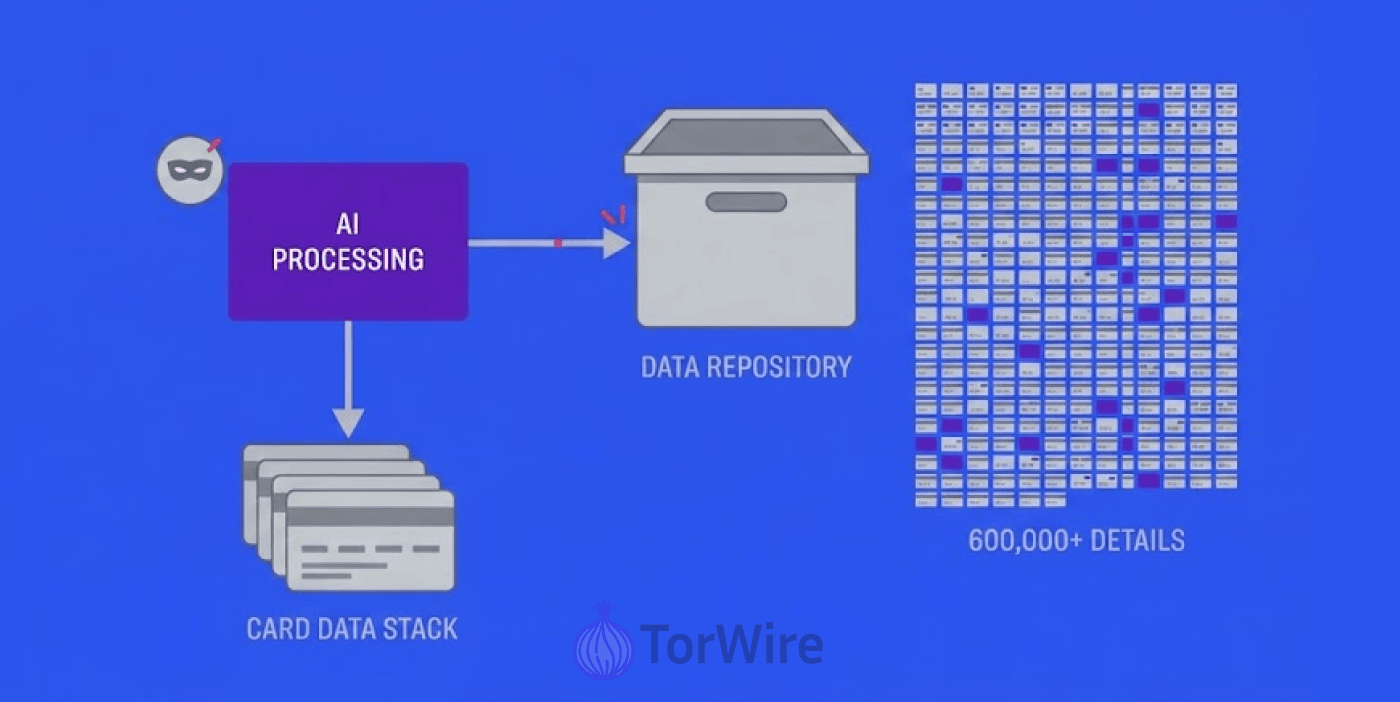
A threat actor used three open-source AI tools to attack hundreds of online stores and steal over 600,000 credit card details.
-
The attacker spent as little as $25 per target, making large-scale hacking cheaper and easier than ever.
-
At least 119 websites were infected with card-stealing malware, including those belonging to a Fortune 500 company and a major U.S. airline.
A financially motivated hacker has been using artificial intelligence tools to run a massive credit card theft campaign. The attacker hit online retailers across the world, stealing payment data at a scale that was previously hard to pull off alone.
Cybersecurity startup Gambit uncovered the campaign. According to their findings, the attack has been running since at least July and was still ongoing as of September 22. In just five days, the attacker hit at least 27 companies and launched more than 100 separate attacks.
In total, the campaign infected at least 119 websites with card-stealing software known as skimmers. The stolen data included more than 600,000 valid card details, taken from just two of the targeted companies alone.
Three AI Tools Did Most of the Work
What makes this campaign stand out is how it was carried out. The attacker used three AI-powered tools to run the operation. Each tool had a specific job.
The first tool, called Strix, handled scanning. It looked for weak points across hundreds of websites. Between August 23 and 31, Strix ran 146 times against 138 different targets, racking up 633 hours of scanning. The second tool, called Cairn, handled the actual break-in. Its job was to gain access to a website’s systems, either through a shell or admin login.
The third tool, Hermes, was in charge of everything else. It managed the overall campaign, made decisions during the attack, and directed the other tools. Hermes used a built-in persona called “SOUL – Red Team Operator” and came loaded with 121 skills, 78 of which were attack-focused. It ran on claude-opus-4.6, a powerful AI model, to make decisions and guide the operation.
According to Gambit, the person behind the campaign appears to be based in China. That person gave the AI tools a short set of goals, then let them handle the rest on their own. Between September 10 and 15, the attacker launched 105 separate attack waves. At least 27 of those succeeded to some degree.
Skimmers Hidden Inside Checkout Pages
Once the attacker gained access to a website, they planted skimmers in different ways depending on how deep their access went.
Some skimmers were added to real JavaScript files already running on the site. Others were slipped into checkout pages or Google tag blocks. In some cases, the attacker poisoned content stored in cloud systems, like S3 buckets or CDN caches. Other methods included changing database fields, altering cloud deployment settings, and using scheduled tasks to reinstall the skimmer if it was ever removed.
The attacker also had a cleanup routine built into the operation. According to Gambit, one of Hermes’s skill files included a clear instruction: after pulling all card data, delete it from the website’s database in batches. This step was meant to cover tracks, but it caused data losses at several retailers as a side effect.
The targets were not chosen randomly. The attacker used a website traffic ranking service to sort through the list of sites Strix flagged. Sites running custom-built software got priority, likely because they were seen as easier to break into. Among the confirmed victims were a Fortune 500 hospitality company, a major U.S. airline, a large industrial supplies distributor, and an online fashion retailer.
Other recent breaches have also exposed customer contact information, showing that attackers can obtain valuable personal data even when payment details are not involved. Integra credit hit by data breach, 134,000 customer phone numbers exposed covers one such incident involving the exposure of customer phone numbers.
Cheap to Run, Hard to Stop
One of the most alarming parts of this campaign is how affordable it was. Gambit researchers found an OpenRouter account linked to the attacker that showed $7,005.71 spent over roughly four weeks as of August 25. Based on later activity, they estimate the total cost of the entire operation fell somewhere between $12,000 and $18,000.
That works out to an average of just $25 per target. As Gambit put it, the operator’s own cost records showed a mean of $25.46 per completed scan, ranging from $3.13 for the cheapest target to $79.31 for the most expensive.
The researchers warn that this low cost changes the threat landscape significantly. Even less skilled attackers can now run large-scale campaigns using AI tools. In several cases, access to a target was gained within just a few hours, with the AI doing the bulk of the work from brief instructions.
Gambit also noted that companies defending against this type of attack need to plan for more than just a data breach. Because of the attacker’s cleanup routine, some victims may also face unexpected data loss, even after the skimmer is removed.